
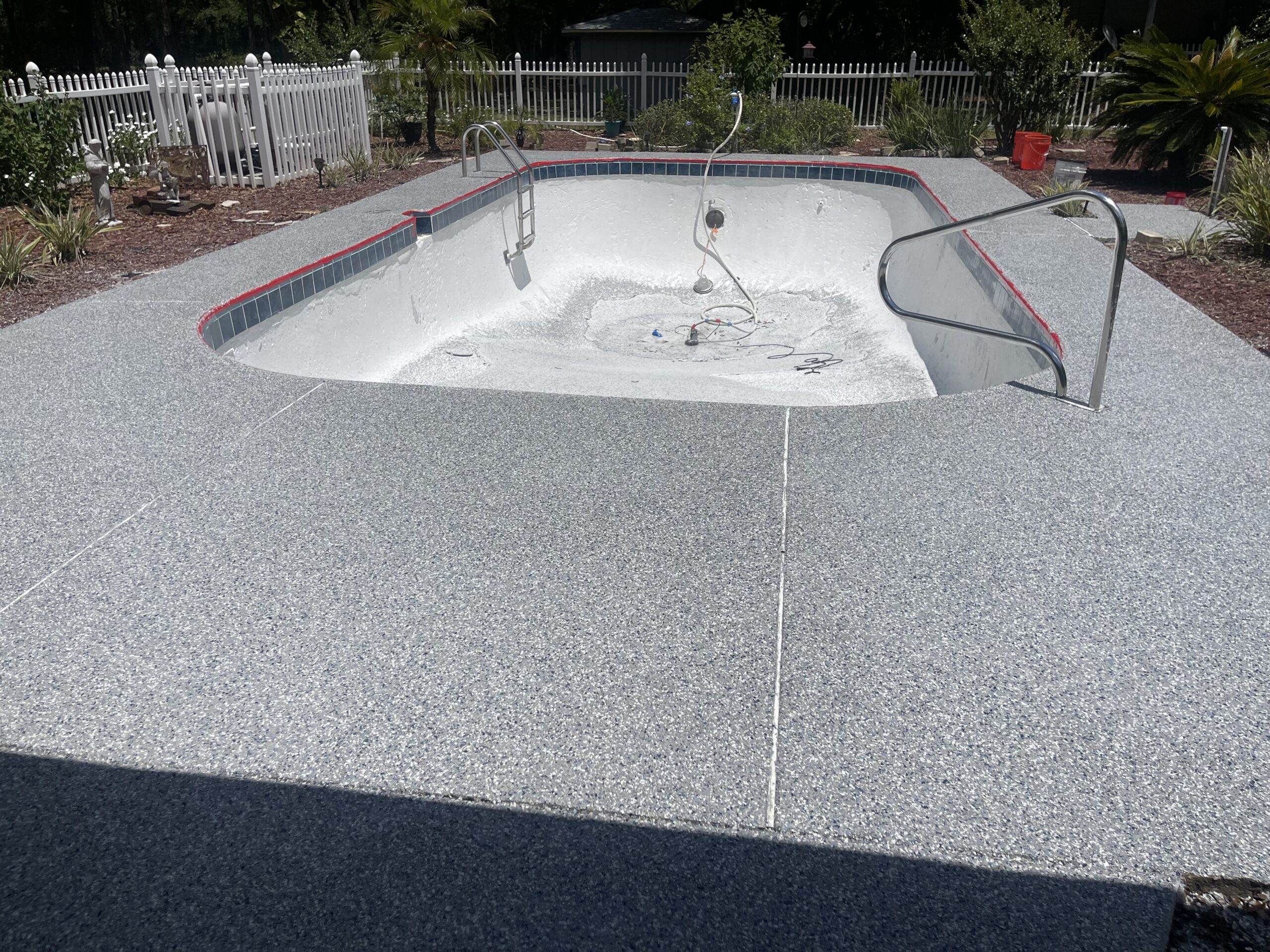

By mid-July in Duval County, a bare concrete pool deck can read 130 to 140 degrees under direct sun — hot enough to send bare feet hopping from the water to the nearest towel. A properly specified pool deck coating changes that experience completely: a lighter, reflective, textured surface that stays noticeably cooler underfoot, grips wet feet, and shrugs off the UV, salt air, and chlorine splash-out that define a Jacksonville summer.
The trouble is that most homeowners think of “coating my deck” as the same job as coating a garage floor. It isn’t. A garage floor lives indoors, out of the sun, and never gets walked on barefoot while dripping wet. A pool deck in Nocatee, Mandarin, or Fleming Island faces the exact opposite conditions, and the wrong product will amber, chalk, and turn slick within a season.
This guide walks through what actually works for a NE Florida pool deck — the chemistry, the texture, the prep on older spalling concrete, and the finish options — so you can tell a real system apart from a garage kit somebody rolled out by the pool.
Why Pool Deck Coating in Jacksonville Isn’t the Same as Garage Epoxy
Standard garage epoxy is an aromatic resin. It’s tough against dropped tools and hot tire pickup — that’s exactly why we use it indoors, and why we wrote a whole breakdown of hot tire pickup on Florida garage floors. But aromatic epoxy has a fatal weakness outdoors: ultraviolet light. Put it under the Jacksonville sun and it ambers (yellows), then chalks and dulls, usually within the first summer.
A pool deck also has two demands a garage never makes. First, it gets walked on barefoot, wet, all day — so slip resistance and surface temperature are safety issues, not preferences. Second, it takes constant chlorinated or saltwater splash-out plus salt-laden air off the Intracoastal and the Atlantic. The coating has to be UV-stable, textured, and chemically resistant at the same time. That combination points to a polyaspartic system, not garage epoxy.
How a Pool Deck Coating Stays Cool-to-the-Touch
Surface temperature comes down to two things: how much solar energy the deck absorbs, and how much it reflects. Dark, bare, or dyed-charcoal concrete soaks up heat and radiates it back into your feet. A cool deck coating flips that equation with light, reflective pigments and a textured surface that holds a thin layer of air against your skin.
In practice, a light sand, bone, or pale gray flake blend can run measurably cooler than adjacent bare concrete on the same afternoon. The texture matters as much as the color — a smooth high-gloss surface transfers heat directly to your foot, while a broadcast-aggregate finish breaks that contact and reads cooler even at the same reflectivity.
Slip Resistance: Broadcast Texture for Wet Feet
A pool deck is wet by definition, and wet feet on smooth coating is how people end up in an urgent-care waiting room. Slip resistance on a real pool deck system comes from a broadcast texture — aggregate thrown into the wet coat so the cured surface has a consistent, barefoot-friendly grip.
We tune the aggregate to the setting. Common options include:
- Fine silica or quartz sand broadcast into the base — the workhorse for a grippy but barefoot-comfortable pool deck.
- Decorative color flake that adds both grip and a speckled, cool-toned look popular around Fleming Island and Julington Creek pools.
- Polymer aggregate for higher-traffic or steeper transitions near steps and spa edges.
The goal is a surface that grips a dripping foot without shredding it — aggressive enough to be safe, fine enough that kids and grandparents can still walk it comfortably. That balance is a judgment call we make on-site based on how the deck slopes toward the coping and drains.
UV Stability and the NE Florida Sun
Jacksonville gets brutal, direct UV load for most of the year, and salt air near the coast accelerates surface breakdown. This is where polyaspartic earns its place. A polyaspartic pool deck topcoat is aliphatic — chemically built to resist ultraviolet light — so it holds its color and clarity instead of yellowing and chalking the way aromatic epoxy does outdoors.
That UV stability is the difference between a deck that still looks right in year five and one that’s gone dull and blotchy by the next pool season. It’s also why we never recommend a straight garage epoxy kit for an outdoor deck, no matter how well it performed in the garage.
| Property | Standard Garage Epoxy | Polyaspartic Pool Deck System |
|---|---|---|
| UV stability | Ambers and chalks outdoors | Aliphatic, UV-stable, color-holding |
| Surface temperature | Often smooth and heat-transferring | Reflective, textured, cooler underfoot |
| Slip resistance (wet) | Slick unless modified | Broadcast texture engineered for wet feet |
| Salt / chlorine splash | Vulnerable at the surface | Chemically resistant topcoat |
| Return to use | Multi-day cure typical | Fast cure, often same/next day |
| Best environment | Indoor garage | Outdoor pool deck |
Prepping an Older Concrete Pool Deck
Most NE Florida pool decks we coat aren’t new — they’re 15 to 30 years old, poured over sandy soil with a high water table, and they show it. A concrete pool deck coating only lasts as long as the prep underneath it, so this is where the real work happens.
Older Duval and St. Johns decks typically arrive with three problems: surface spalling (flaking from years of sun, moisture, and pool chemicals), cracking from minor slab movement over sandy sub-base, and previous sealer or paint that’s failing. We diagnose all three before we quote a finish.
Our prep sequence generally runs:
- Mechanical profiling — diamond grinding or shot blasting to open the concrete and remove failed coatings, not acid-washing, which doesn’t give a reliable bond.
- Spall and crack repair — grinding out compromised areas and rebuilding them with polymer-modified patch material so the surface is sound before anything goes over it.
- Moisture assessment — critical near the water table you find across Nassau and coastal St. Johns, where slabs can drive vapor up into a coating if it isn’t accounted for.
- Cleaning and profiling check before the first coat goes down.
Choosing a Pool Deck Coating Finish: Knockdown, Flake, or Microtopping
Once the slab is sound, the finish is where personality and performance meet. Three systems cover almost every Jacksonville pool deck, and each grips and looks a little different.
- Knockdown texture — a troweled, “knocked down” cementitious or polymer overlay that gives a rolling, orange-peel-style grip. It’s a favorite for reworking dated, splotchy decks into a clean, cohesive look, and the texture itself provides excellent barefoot traction and a cooler feel.
- Full flake (chip) broadcast — decorative vinyl flake broadcast to rejection into the base, then locked under a UV-stable polyaspartic topcoat. It hides imperfections, adds grip, and lets you dial in cool-toned color blends. This is the most popular look on newer Nocatee and Ponte Vedra pools.
- Microtopping — a thin, hand-applied cement overlay that can mimic a smooth, modern concrete or stone aesthetic. It’s the design-forward option, sealed with the right texture additive so it stays slip-safe rather than becoming a wet slide.
There’s no single “best” — the right pick depends on your deck’s condition, sun exposure, and the look you’re after. A heavily spalled deck often wants a knockdown or flake system to unify the surface, while a sound deck with a modern home may suit a microtopping.
Salt, Chlorine, and Saltwater Pool Resistance
Splash-out is constant, and a growing share of Jacksonville pools run saltwater chlorine generators, so the deck coating has to tolerate both salt and chlorine at the surface. A polyaspartic topcoat is chemically resistant to the pool chemistry it lives next to, and because it cures into a dense, non-porous film, it doesn’t drink up chlorinated water the way bare or lightly sealed concrete does.
Coastal air adds a second load. Homes near Fernandina Beach, the Intracoastal, and the beaches take salt-laden air year-round, which is hard on any exterior surface. A properly topcoated deck resists that surface attack far better than paint or a basic acrylic sealer, which is why we treat the slip resistant coating topcoat as the protective layer, not just the pretty one.
Cure Time and What to Expect
One of the practical advantages of a polyaspartic system in Florida is speed. Polyaspartics cure fast, which means a pool deck can often return to foot traffic the same day or the next, versus the multi-day wait a full epoxy buildup can demand. That matters when a summer afternoon thunderstorm can roll in on short notice — a faster cure window gives us more room to work between weather.
Timeline varies with the system, the deck’s condition, and humidity, but a typical resurface runs a few working days: prep and repair, base and broadcast, then topcoat. We’ll give you a real schedule for your specific deck, including when it’s safe to walk on, when furniture can come back, and when the pool is back in full use.