

Cracks in Your Garage Floor: Which Ones a Coating Fixes and Which Ones Come Back
Which garage floor cracks a coating fixes for good, which ones will show back through

July 8, 2026
You walk into your garage on a hot August afternoon, and there it is: two ugly patches on the floor, shaped almost exactly like where your tires sit. The coating is curled at the edges, maybe bubbled, maybe pulling up in sticky sheets. It looks like your whole epoxy floor is failing. In reality, you’re looking at one of the most common and most misunderstood coating problems in Florida garages: hot tire pickup.
Here’s the frustrating part. Hot tire pickup almost never means your slab is bad or that epoxy “just doesn’t work.” It means the coating you have wasn’t built for the heat and moisture your tires and your Florida climate throw at it. And once you understand the mechanism, the fix becomes obvious: it’s about bond strength, the right chemistry, and honest surface prep.
In this guide, you’ll learn exactly what hot tire pickup is and how to tell it apart from normal tire marks, why Florida’s heat and coastal humidity make it worse than almost anywhere in the country, why big-box DIY epoxy kits fail first, and how a properly installed epoxy-and-polyaspartic system stops the problem for good. We serve garages across Jacksonville, metro Atlanta, Savannah, Charleston, Fort Myers, and Boca Raton, and we see this same failure pattern week after week. Let’s break down what’s really happening under your tires.
Hot tire pickup is when your garage floor coating lifts, curls, or pulls away from the concrete in patches that match your tire footprint. The coating literally releases from the slab and grabs onto the tire instead. You’ll see it right where the car parks, and nowhere else on the floor. That localized pattern is the giveaway.
People confuse it with ordinary tire scuffing, so here’s how to tell the difference. Normal tire marks are surface discoloration; you can often clean them, and the coating underneath is still solid and bonded. Hot tire pickup is structural failure of the bond. Look for these signs:
Why does it concentrate exactly under the tire and not across the whole floor? Because that’s the only place a hot, heavy, contracting rubber surface presses down and grips. The rest of your floor never sees that combination of heat, weight, and pull. So a weakly bonded coating survives everywhere except the one place it gets tested hardest. That’s also why a spot repair on the tire zone alone usually doesn’t hold: the same weak bond exists under the whole floor, waiting for its turn.
To understand the fix, you have to understand the physics, and it’s simpler than it sounds. When you drive on Florida asphalt in summer, that pavement can sit well above 95F in direct sun. Your tires, from friction and road heat combined, routinely climb to 140F or higher on a highway run. Then you pull into the garage and park.
Now a hot tire is pressed against your floor coating with the full weight of the vehicle on it. Heat transfers from the rubber into the coating. If the coating has a low heat tolerance, it softens slightly at that contact point. As the tire cools over the next hour or two, the rubber footprint contracts and grips whatever it’s touching. If the coating is only weakly bonded to the concrete, the cooling, shrinking tire wins the tug-of-war and peels the coating up off the slab.
Cheaper coatings make this worse in two ways. First, they re-soften more easily under tire heat, so the bond is even more compromised at the exact moment of stress. Second, they never fully hardened to begin with, so the tire’s grip meets almost no resistance. A high-quality, properly cured coating stays hard through that heat cycle and simply doesn’t let go.
This mechanism is identical in Jacksonville, Fort Myers, Boca Raton, Savannah, and Charleston. The difference from a garage in Ohio or Michigan is that Florida delivers this thermal cycle nearly every day for months on end, with no winter recovery period. Your floor gets stressed and re-stressed continuously all summer. That’s why weak coatings that might limp along for years up north can fail here in a single season.
If you bought a garage floor kit off the shelf and rolled it on yourself, and it’s now lifting under your tires, you’re not alone, and it’s not because you did the job badly. It’s usually the product and the process. Here’s the honest breakdown.
Low solids content. Many DIY kits are what the trade calls paint-grade or water-based epoxy, often in the range of roughly 5 to 12 percent solids. That means most of what you rolled on evaporated, leaving a thin film that behaves a lot like heavy latex paint. It has low heat tolerance and thin build, exactly the wrong combination for hot tires.
Weak surface prep. Most kits tell you to clean and acid-etch the concrete. Etching lightly opens the surface, but it does not create the deep mechanical profile a durable coating needs to lock into. Without real profile, the coating is essentially sitting on top of the slab rather than keyed into it, so the tire has an easy time pulling it off.
Rushing return to service. The instructions may say you can park on it in a day or two. In humid Florida conditions, coatings cure slower, and driving on a floor before it has fully cross-linked leaves it soft and vulnerable to the very first hot day.
Put those three together and you get the real-world DIY timeline we see constantly in coastal and inland Florida garages: not years, but months. Sometimes a single summer. It’s disappointing, but it’s predictable, and it points straight at the actual root cause.
Have a pro evaluate the bond, moisture, and coating chemistry before you patch over the problem and pay for it twice.
Request a Free EstimateStrip away the symptoms and hot tire pickup comes down to one thing: the coating never bonded to the concrete strongly enough to resist the tire’s pull. Everything else is downstream of that. So the single most important step in any floor that survives Florida summers happens before a drop of coating goes down.
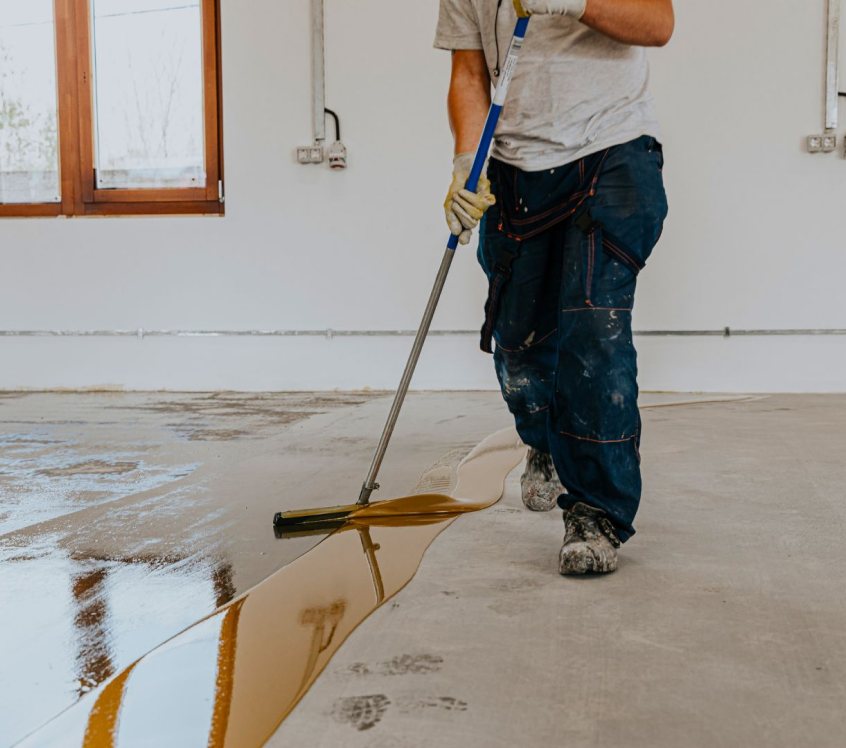
Mechanical diamond grinding. A professional install starts by grinding the slab with diamond tooling. This does two things at once: it removes surface contaminants and laitance, and it creates a concrete surface profile, a controlled roughness the coating flows into and locks onto as it cures. That mechanical key is what fights the tire. Etching with acid, the DIY standard, cannot produce anything close to the same profile. It under-profiles the slab and leaves the coating with little to grab.
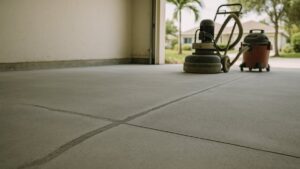
Crack and spall repair. Before coating, cracks, pits, and spalled areas get repaired and filled. If you skip this, tires tend to lift the coating right at those weak seams, because the bond is already compromised there. Fixing them first removes the easy starting points for peeling.
When the profile is right and the repairs are done, the coating becomes part of the floor rather than a skin sitting on it. Under those conditions, a hot, contracting tire can grip all it wants; the coating stays locked into the concrete and simply doesn’t release. That’s the whole game. Chemistry helps, and we’ll get to it, but bond strength is the foundation everything else stands on.
Once the bond is right, the next lever is the coating chemistry itself, and this is where polyaspartic earns its reputation. Polyaspartic is a fast-curing, extremely durable coating, and its most relevant trait for Florida is its heat resistance.
The key concept is glass transition temperature, the point at which a coating starts to soften from a hard solid toward a rubbery state. Polyaspartic formulations engineered for garage floors have a glass transition temperature well above 200F, with systems commonly engineered to handle 300F and up. Compare that to a 140F tire. The tire heat isn’t even close to the point where a quality polyaspartic softens. So the mechanism that lifts cheap coatings, softening under tire heat, simply doesn’t get triggered.
Polyaspartic also cures harder than paint-grade epoxy and stays hard through repeated thermal cycling all summer long. It doesn’t fatigue and go tacky the way a low-solids film does after a few hundred hot-park cycles. Paired with a proper epoxy base coat over a ground-and-profiled slab, you get a full system that bonds into the concrete rather than resting on top of it:
There’s a bonus, too. Polyaspartic cures fast, which means a quicker return to service. Fewer floors get driven on before they’re ready, so you eliminate one of the most common early-failure triggers at the same time you gain heat resistance.
Heat gets all the blame, but in coastal Florida it has a silent partner: slab moisture. Concrete is porous, and water vapor moves up through it from the ground below. When that vapor pressure is high, it pushes against the underside of a coating. The result is bubbling, blistering, and a weakened bond, which is exactly the condition that makes hot tire pickup far more likely. Weak bond plus hot tires equals lifting.
This is why professionals test before they coat. ASTM moisture testing, including moisture vapor emission rate (MVER) and relative humidity probes, measures how much vapor the slab is actually pushing out. In Jacksonville, Savannah, and Charleston, high water tables and coastal humidity routinely push these readings toward the upper end of the acceptable range. A slab that would test fine in Arizona can be borderline or over the limit here.
When moisture is high, the answer is a moisture-vapor barrier primer, a specialized coat that seals the slab and controls vapor so the main coating can bond and stay bonded. Skipping that step on a damp coastal slab is one of the most common reasons floors fail early in our region. And this is precisely why Florida floors let go where dry-climate floors survive: it isn’t heat alone, it’s heat and humidity working together on the same weak bond.
You don’t need a lab to get a rough read on your own floor. Try this quick self-check, ideally on a hot day after the car has been parked a while:
Warning signs that your current floor probably won’t survive another Florida summer include a thin roller-applied kit finish, visible bubbling anywhere, any softness underfoot in the tire area, and prep you know was acid-etch-only. If you check two or more of those boxes, it’s worth booking a professional evaluation before the next heat wave finishes the job for you.
Here’s the hard truth about repairs. If the underlying floor is soft or was never properly profiled, a spot patch over the tire zone only delays the next failure. You’re bonding a patch to a surface that already proved it can’t hold, and the same heat-and-contraction cycle will find the next weak spot, or lift the patch itself. Spot repair makes sense only when the surrounding floor is genuinely sound and the damage is isolated and superficial.
When the floor is a low-solids DIY kit, or the prep was etch-only, or moisture was never addressed, the durable fix is a full grind-and-recoat with a polyaspartic system. That means grinding off the failed coating, re-profiling the slab, repairing cracks and spalls, testing and controlling moisture, and installing an epoxy base with a polyaspartic topcoat. Done once, correctly, it ends the cycle instead of resetting the clock.
A professional evaluation exists to tell you which path you’re on. A good assessment checks the four things that actually determine success: bond strength, slab moisture, prep quality, and coating chemistry. Those four decide whether your floor lasts.
In the meantime, a few habits can slow the damage as a stopgap, though none of them fix a weak floor: park on tire mats to break direct hot-rubber contact, rotate the car’s position slightly so the same spot isn’t stressed every day, and clean with mild cleaners rather than harsh solvents that attack the coating. Think of these as buying time until you can get the floor properly done, not as a cure.
| Factor | DIY Paint-Grade Epoxy Kit | Professional 100%-Solids Epoxy | Epoxy Base + Polyaspartic Topcoat |
|---|---|---|---|
| Solids & heat tolerance | Low solids (~5–12%); softens under tire heat | High solids; solid heat tolerance | High glass transition temp (200F+, often engineered 300F+); unaffected by hot tires |
| Surface prep | Acid etch only; under-profiled slab | Diamond grinding; proper mechanical profile | Diamond grinding plus crack/spall repair |
| Moisture handling | Typically none; no MVER testing | Moisture testing; barrier primer if needed | Full ASTM testing plus vapor-barrier primer on coastal slabs |
| Hot tire pickup resistance | Poor; lifts readily | Good with proper install | Excellent; engineered to resist it |
| Typical FL lifespan before failure | Months to a season | Many years with correct prep | Longest-lasting of the three; built for FL heat and humidity |
From Jacksonville to Fort Myers, Boca Raton, Savannah, and Charleston, we install epoxy-and-polyaspartic systems engineered for our heat and humidity. Get an honest evaluation of your floor.
Request a Free EstimateHot tire pickup is almost always a preventable failure — it comes down to slab prep and matching the coating system to Florida heat. If your garage floor is already lifting, or you want a coating engineered to survive hot tires from day one, our team can help you get it right the first time.
Which garage floor cracks a coating fixes for good, which ones will show back through
How a metallic epoxy floor gets its depth and movement, why no two floors ever

How a static-control floor is actually built: the embedded grounding grid, the conductive layers above

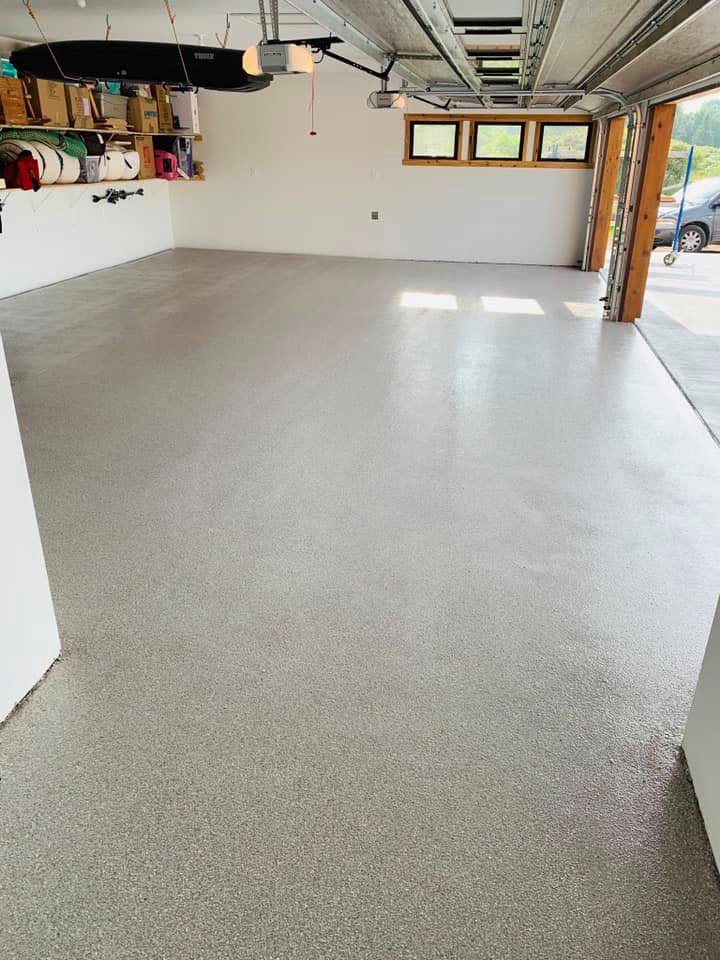
Garage Floor Special
One Flat Price for Your Garage Floor
Claim Your Price
Answer a few quick questions and we'll reach out to set up your free estimate.