


Best Garage Floor Coating: How to Pick the Right System
The best garage floor coating for Florida, Georgia and Carolina garages: epoxy, polyurea and polyaspartic

June 30, 2026
The Short Version
Polyaspartic garage floors cost roughly $7–$12 per square foot installed, cure in 1 day, hold color under UV, and last 15–20 years — but they slip more when wet, are harder to spot-repair, and cheap formulas yellow within 2 years. For most Florida garages, an epoxy base with a polyaspartic topcoat (the Apex Hybrid) outperforms either chemistry alone.
Polyaspartic garage floor coatings are having a moment. Every contractor’s truck has the word stenciled on the side, every Facebook ad promises a “one-day install that lasts a lifetime,” and the product really is impressive — UV-stable, fast-curing, and tougher than the epoxy it’s slowly replacing. But polyaspartic is not a miracle, and the way it gets sold often glosses over real drawbacks that a homeowner deserves to hear before signing a contract. After installing thousands of square feet of every coating chemistry made, here’s the honest picture: where polyaspartic shines, where it stumbles, what it actually costs in Florida and South Carolina garages, and the one hybrid system Apex Epoxy Flooring of Jacksonville uses on most residential jobs because it solves the problem polyaspartic alone can’t.
Polyaspartic is an aliphatic polyurea — a two-component reaction product of an aliphatic polyisocyanate and a polyaspartic ester resin. In plain English: it’s a cousin of polyurethane that cures by a slower, more controllable version of polyurea’s chemistry, which is why it dries fast enough to recoat in 60–90 minutes but slow enough to roll out without curing in the bucket. It was originally developed by Bayer in the early 1990s for steel-bridge coatings — places where they needed UV stability, abrasion resistance, and the ability to apply in marginal weather. Garages came later.
Polyaspartic is not epoxy. It is not “modified epoxy” or “epoxy 2.0,” and any sales pitch using those terms is mislabeling the product. Epoxy and polyaspartic have different chemistries, different cure mechanisms, and different long-term behaviors. Polyaspartic is also not the same as polyurea (its faster, more brittle cousin used in truck bed liners). And it is not, by itself, a “garage floor coating” — it is a clear or pigmented topcoat that performs best when applied over a properly bonded base layer. The single-coat polyaspartic jobs you sometimes see at the low end of the market are technically possible, but they sacrifice the build thickness and chip-broadcast layer that give a coating its visual texture and structural durability.
The word “aliphatic” is the one that should appear on any product spec sheet you’re handed. Aliphatic polyaspartics are UV-stable — they won’t yellow in sunlight. Aromatic polyaspartics (rare in residential garage work but they exist on the cheap end) will amber and fade within 18–24 months of UV exposure. If your installer can’t tell you which one they’re spraying, that’s a problem worth pressing on.
This is the comparison that determines which coating ends up on most garage floors. Both work. Both can last 15–20 years installed correctly. They are not the same product, and the differences matter for some homeowners more than others.
| Property | Polyaspartic | Traditional Epoxy |
|---|---|---|
| Recoat window | 60–90 minutes | 12–24 hours |
| Full cure (drive on) | 1–2 days | 5–7 days |
| UV stability | Excellent (aliphatic) | Poor — yellows in months |
| Abrasion resistance | Higher (Taber CS-17 ~25mg loss) | Good (Taber CS-17 ~35mg loss) |
| Cost per square foot | $7–$12 installed | $5–$9 installed |
| Pot life (working time) | 20–30 minutes | 30–60 minutes |
| Recoatability years later | Difficult — needs full sand | Moderate — chemical re-bond possible |
| Color/design flexibility | Mostly clear topcoat over flakes | Full color base + flake or metallic |
| Humidity sensitivity | High during application | Moderate — can blush over 80% RH |
| Installer skill required | High (fast pot life punishes mistakes) | Moderate (forgiving working time) |
“Polyaspartic lets you drive on the floor the next day. A traditional epoxy install ties up your garage for the better part of a week before tires can touch it.”
The summary read is this: polyaspartic wins on speed, UV stability, and a slight edge on abrasion. Epoxy wins on cost, working time, and color/design range (most metallic, marbled, and full-color designer floors are built on an epoxy base because polyaspartic’s short pot life makes intricate finishes impractical). Neither is “better” in isolation — they’re built for different priorities.
The number that gets quoted publicly is usually too low. Real installed cost for a quality polyaspartic system in Florida or coastal South Carolina lands between $7 and $12 per square foot for a single-color base with flake broadcast and a clear polyaspartic topcoat. For a typical 500 sq ft two-car garage that’s $3,500 to $6,000. Big variance, and the variance is real because the number of coats, the brand of resin, the prep condition of the slab, and whether moisture mitigation is needed all move the price.
| Garage Size | Budget (single-coat) | Mid (standard) | Premium / Hybrid |
|---|---|---|---|
| 1-car (~250 sq ft) | $1,250–$1,500 | $1,750–$2,250 | $2,500–$3,250 |
| 2-car (~500 sq ft) | $2,500–$3,000 | $3,500–$4,500 | $4,500–$6,500 |
| 3-car (~750 sq ft) | $3,750–$4,500 | $5,250–$6,750 | $6,750–$9,750 |
| 4-car / oversized (1,000+ sq ft) | $5,000+ | $7,000+ | $9,000+ |
At the $5–$6 per square foot end, you’re getting a thin, often single-coat polyaspartic with light flake broadcast and minimal prep — typically acid etch rather than diamond grinding. These jobs look fine for a year or two and then start peeling at the garage door threshold where hot tires repeatedly hit the same spot. At $7–$9 you’re getting a real diamond-grind prep, a base coat with full flake broadcast, and a single clear polyaspartic topcoat. This is the sweet spot for most residential installs. At $10–$12 you’re getting either a hybrid system (epoxy base plus polyaspartic top, which we’ll get to) or a premium polyaspartic with double topcoats for thicker build and longer wear life — common on commercial showrooms and high-traffic residential bays.
Most installers run a fixed mobilization cost — equipment rental for the grinder, dehumidifier, vacuum, plus crew transit. That fixed cost spreads across the square footage, so a 1,000 sq ft three-car garage often costs less per foot than a 400 sq ft single bay. Charleston-area jobs tend to run 5–10% higher than Jacksonville because of the longer drive time and ferry/bridge logistics for some neighborhoods, while Savannah and Tampa-area pricing typically tracks within a dollar of Jacksonville’s range.
The headline price almost never includes these line items. Open each one before signing — if any apply to your slab and they aren’t accounted for, you’ll see them as change-orders mid-install.
If a quote is dramatically below the others, ask which of these are included and which are change-order items if discovered during prep.
The trade-offs are real on both sides. Click through each panel below for the honest pros and cons most sales decks leave out.
The cons list above is honest, but a few items deserve a longer look. These are the ones that most often surface as complaints six months after install.
A smooth polyaspartic topcoat without aggregate added is genuinely slick when wet. Track in some rainwater on a Tuesday morning and a polyaspartic floor with no anti-slip additive has a coefficient of friction that drops to around 0.4 — below the OSHA recommended 0.5 for walking surfaces. The fix is simple: a polymer anti-slip aggregate (Shark Grip, polypropylene shot, or aluminum oxide) broadcast into the topcoat. Every installer offers it. Not every installer mentions it. Always ask, and if you have kids, dogs, or anyone with mobility issues using the garage, insist on it.
Polyaspartic cures into a tight chemical network that doesn’t accept a fresh polyaspartic coat well after the surface has aged. To recoat a 5-year-old polyaspartic floor, the installer has to fully sand the surface with 80-grit to break the gloss and create mechanical tooth, then apply a tie-coat primer, then the new polyaspartic. By contrast, a 5-year-old epoxy floor can often be lightly scuff-sanded and direct-recoated. Practically, this means a damaged polyaspartic floor that needs a section repair almost always shows a visible patch outline, while an epoxy patch can blend in more cleanly.
Aliphatic polyaspartic is supposed to be UV stable, and brand-name resins from SPARTACOTE, Citadel, Versatile Building Products, and Sherwin-Williams General Polymers genuinely are. But the market is flooded with cheaper polyaspartic resins (often imported, often unlabeled as to whether they’re true aliphatic or a blend) that yellow visibly within 18–36 months. The yellowing is most obvious on white, gray, and pastel base colors. If your garage gets significant direct UV through windows or an often-open door, this matters. Demand the product data sheet and look for the term “aliphatic” plus a yellowing index spec (Delta-b under 2 after 1,000 hours QUV testing is good).
Polyaspartic chemistry reacts with ambient moisture during cure. Above 75% relative humidity, or when the slab surface is colder than the dew point, the curing reaction produces CO2 bubbles trapped in the film — small surface pinholes or microblistering that compromise the wear surface and look like a permanent haze. Jacksonville and Charleston routinely hit 80–90% RH from May through October. A serious crew brings a portable dehumidifier and an infrared thermometer to every install; a casual crew rolls coating onto a 70°F slab in 85% humidity and prays. The product datasheets all warn about this. Most homeowners never see the warning.
“Jacksonville and Charleston routinely hit 80–90% relative humidity from May through October — the exact conditions polyaspartic chemistry hates. The installer’s dehumidifier matters as much as the coating brand.”
Once mixed, polyaspartic has 20–30 minutes of working time before it starts to thicken in the bucket. Epoxy gives you 30–60 minutes. That extra time isn’t laziness padding — it’s recovery time. If a coat goes down with a holiday (a missed spot), epoxy lets you fix it before kicking; polyaspartic frequently does not. This is why polyaspartic installs reward experienced crews and punish casual ones. The fastest-curing chemistry on the market also has the smallest margin for error.
Not every garage should get polyaspartic. Here are the situations where a traditional epoxy or hybrid system is genuinely the better answer. Open each panel to see whether your situation fits.
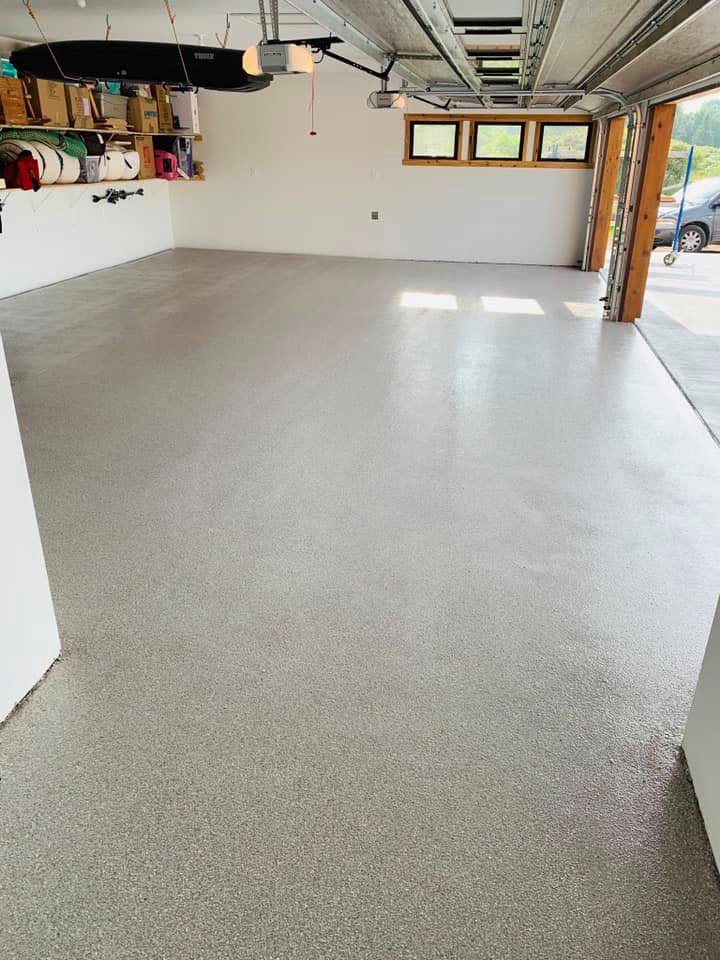
For roughly 70% of the residential installs Apex Epoxy Flooring does across Jacksonville, Charleston, Savannah, Tampa, and the Atlanta metro, the answer to “epoxy or polyaspartic?” is “both.” A hybrid system uses 100% solids epoxy as the base coat — pigmented in your color, with a full flake broadcast — then tops it with a clear aliphatic polyaspartic. You get the best of both chemistries.
The epoxy base coat does what epoxy does well: deep, rich color, generous working time for clean flake broadcast, full color and design range, strong mechanical bond to the prepped slab, lower material cost on the thickest coat. The polyaspartic topcoat does what polyaspartic does well: UV stability so the color doesn’t yellow, faster cure so you’re back in the garage by the next day, harder abrasion resistance against hot tires and dropped tools, and a glossier, easier-to-clean wear surface. The combined system costs $9–$13 per sq ft installed and outlasts either chemistry alone.
The hybrid is two days on site instead of polyaspartic’s one, but the result lasts measurably longer.
A correctly-installed hybrid system in a Jacksonville two-car garage typically shows no measurable wear at the 7-year mark and minor edge wear at 12–15 years. The same garage with single-coat polyaspartic over insufficient prep often shows hot-tire pickup by year 3 and visible flake loss by year 5. Apex backs hybrid installs with a 15-year residential warranty that covers peeling, hot-tire pickup, and UV yellowing — full disclosure of what’s covered up front, no asterisks burying common failures.
If you’re weighing polyaspartic for a garage in Jacksonville, Charleston, Savannah, Tampa, Boca Raton, or the Atlanta metro, the right next step is a no-pressure walkthrough where an installer measures the bay, runs a quick moisture and prep assessment, and gives you a real number with the line items spelled out. Apex Epoxy Flooring will tell you straight up when polyaspartic is the right choice, when traditional epoxy makes more sense, and when our hybrid epoxy-plus-polyaspartic system is the better investment for your specific slab and how you use the space. No upsell pressure, no rushed close — just the actual answer for your garage. Call (904) 595-9792 or request your free in-home quote online, and we’ll be out within a few business days.
Polyurea garage floor coating offers a smart, long-term solution for homeowners looking to improve both the look and performance of their space. With its fast-curing application, it stands up to Florida’s climate and daily use without losing its appeal. For those seeking durability, safety, and a polished finish, polyurea flooring delivers both function and style that lasts.
The best garage floor coating for Florida, Georgia and Carolina garages: epoxy, polyurea and polyaspartic
Which garage floor cracks a coating fixes for good, which ones will show back through
How a metallic epoxy floor gets its depth and movement, why no two floors ever

Garage Floor Special
One Flat Price for Your Garage Floor
Claim Your Price
Answer a few quick questions and we'll reach out to set up your free estimate.