
Most people who call us about a driveway have already seen a finished garage floor and want that look out front. The honest answer is not the one that sells the most work.
Standard epoxy is the wrong product for a Florida driveway. Epoxy is aromatic chemistry, so UV breaks it down: in full Northeast Florida sun it ambers (turns yellow-brown) in about 6 to 18 months and chalks to a dull, powdery surface within 2 to 3 years. What holds up outdoors here is a UV-stable polyaspartic or polyurea system with a broadcast texture, roughly $6 to $12 per square foot installed with an 8 to 15 year service life, or a penetrating sealer at $1 to $2.50 per square foot refreshed every 2 to 4 years. On a driveway specifically, we talk a real share of callers out of coating at all.
Here is the reasoning, and the cases where we would tell you to keep your money.
Four things go wrong, and they compound.
Ultraviolet light. Epoxy resin is not UV stable, and a driveway has no roof, no lanai screen, and no shade. That is why “epoxy floor yellowing” is a search term. It is not a defect, it is the chemistry doing what it does.
Heat. A dark exterior slab in Duval County reaches 130 to 150 degrees at the surface on an August afternoon. Concrete expands and contracts against a film that moves at a different rate, and the bond lets go at edges and control joints.
Moisture from underneath. Your garage slab may sit on a poly vapor barrier. Your driveway almost certainly does not. It sits on sand, the water table is shallow, and we get 50-plus inches of rain a year. That vapor drives upward, a film traps it, and you get blisters, white bloom, and delamination. Same reason we repair concrete spalling before any coating goes down.
Turning shear and hot tire pickup. In a garage you park and walk away. On a driveway you crank the wheel while nearly stationary, and a hot tire lifts a soft coating in a crescent.
Freeze-thaw, incidentally, does not apply here. Most driveway advice online is written for Ohio and Michigan. Our enemies are UV, heat, and vapor drive.
| System | Cost per sq ft | Life in NE Florida | Holds color in sun | Best use |
|---|---|---|---|---|
| Standard or big-box epoxy | $2 to $5 | 1 to 3 years | No | Interior garage only |
| Polyaspartic or polyurea, quartz or flake | $6 to $12 | 8 to 15 years | Yes | Garages, pool decks, entryways |
| Cementitious overlay or spray texture | $5 to $10 | 7 to 12 years, reseal every 3 to 5 | With a UV-stable topcoat | Sound but ugly concrete |
| Penetrating silane or siloxane sealer | $1 to $2.50 | 2 to 4 years | No film to fade | Almost any driveway |
| Tear out and replace | $8 to $15 | 25 years plus | Not applicable | Cracked or settled slabs |
The chemistry that survives outdoors is aliphatic: the molecule does not come apart under UV. Polyaspartic and polyurea are aliphatic. Standard epoxy is not. We break down the real difference between polyaspartic and epoxy coatings and how polyurea stands up to Florida heat and UV separately.
Texture matters as much as chemistry. A smooth exterior film in a 50-inch rainfall climate is a slip hazard, which is why our cool, slip-resistant pool deck coating uses broadcast aggregate instead of gloss.
The garage floor: a controlled slab
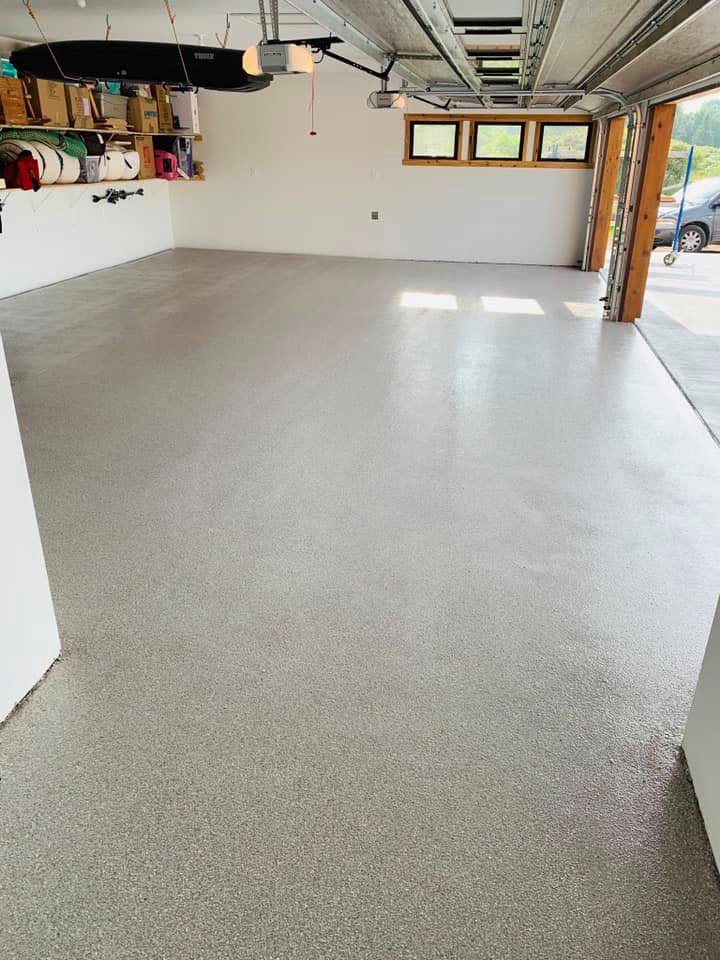
We coat garage floors all day, and current promotional pricing there starts around $2,300 for a two-car and $3,200 for a three-car, installed in one day: walk on it in 4 hours, drive in 24. Those are introductory garage numbers and sit below the per square foot ranges above, because an enclosed slab is a controlled, repeatable job. That slab is out of the rain, out of the UV, and the car parks without turning.
The driveway: the opposite on every count
A driveway is the opposite on every count, at two to three times the square footage. That is why the honest recommendation on many driveways is a wash and a sealer, not a coating.
When we would tell you not to coat:
A 20×20 driveway is 400 square feet: $400 to $1,000 sealed, $2,400 to $4,800 coated in a UV-stable polyaspartic system. A 1,000 square foot drive runs $1,000 to $2,500 sealed or $6,000 to $12,000 coated. Prep is the swing factor: grinding, joint treatment, and crack repair add $1 to $3 per square foot on a neglected slab.
Installed cost per square foot, Northeast Florida
Bars are scaled to the top of the range, with $15 per square foot as full width.
We install polyaspartic and polyurea coatings on garage floors and pool decks across Duval, St. Johns, and Clay counties, and fix the concrete underneath first when it needs it. If you are weighing a driveway, we will walk the slab, check it for moisture and movement, and tell you whether it is worth coating, sealing, or leaving alone. Sometimes that costs us the job. That is fine.
Call Apex Flooring at (904) 595-9792
Garage Floor Special
One Flat Price for Your Garage Floor
Claim Your Price
Answer a few quick questions and we'll reach out to set up your free estimate.