Blog

Concrete Driveway Coating in Florida: Why Epoxy Fails Outdoors and What Actually Holds Up

Home
/
Blog

Most people who call us about a driveway have already seen a finished garage floor and want that look out front. The honest answer is not the one that sells the most work.

Standard epoxy is the wrong product for a Florida driveway. Epoxy is aromatic chemistry, so UV breaks it down: in full Northeast Florida sun it ambers (turns yellow-brown) in about 6 to 18 months and chalks to a dull, powdery surface within 2 to 3 years. What holds up outdoors here is a UV-stable polyaspartic or polyurea system with a broadcast texture, roughly $6 to $12 per square foot installed with an 8 to 15 year service life, or a penetrating sealer at $1 to $2.50 per square foot refreshed every 2 to 4 years. On a driveway specifically, we talk a real share of callers out of coating at all.

Here is the reasoning, and the cases where we would tell you to keep your money.

Why epoxy fails outdoors in Jacksonville

Four things go wrong, and they compound.

Ultraviolet light. Epoxy resin is not UV stable, and a driveway has no roof, no lanai screen, and no shade. That is why “epoxy floor yellowing” is a search term. It is not a defect, it is the chemistry doing what it does.

Heat. A dark exterior slab in Duval County reaches 130 to 150 degrees at the surface on an August afternoon. Concrete expands and contracts against a film that moves at a different rate, and the bond lets go at edges and control joints.

Moisture from underneath. Your garage slab may sit on a poly vapor barrier. Your driveway almost certainly does not. It sits on sand, the water table is shallow, and we get 50-plus inches of rain a year. That vapor drives upward, a film traps it, and you get blisters, white bloom, and delamination. Same reason we repair concrete spalling before any coating goes down.

Turning shear and hot tire pickup. In a garage you park and walk away. On a driveway you crank the wheel while nearly stationary, and a hot tire lifts a soft coating in a crescent.

Freeze-thaw, incidentally, does not apply here. Most driveway advice online is written for Ohio and Michigan. Our enemies are UV, heat, and vapor drive.

What actually works on an exterior slab

System Cost per sq ft Life in NE Florida Holds color in sun Best use
Standard or big-box epoxy $2 to $5 1 to 3 years No Interior garage only
Polyaspartic or polyurea, quartz or flake $6 to $12 8 to 15 years Yes Garages, pool decks, entryways
Cementitious overlay or spray texture $5 to $10 7 to 12 years, reseal every 3 to 5 With a UV-stable topcoat Sound but ugly concrete
Penetrating silane or siloxane sealer $1 to $2.50 2 to 4 years No film to fade Almost any driveway
Tear out and replace $8 to $15 25 years plus Not applicable Cracked or settled slabs

The chemistry that survives outdoors is aliphatic: the molecule does not come apart under UV. Polyaspartic and polyurea are aliphatic. Standard epoxy is not. We break down the real difference between polyaspartic and epoxy coatings and how polyurea stands up to Florida heat and UV separately.

Texture matters as much as chemistry. A smooth exterior film in a 50-inch rainfall climate is a slip hazard, which is why our cool, slip-resistant pool deck coating uses broadcast aggregate instead of gloss.

The driveway is a harder sell than the garage, and we will say so

The garage floor: a controlled slab

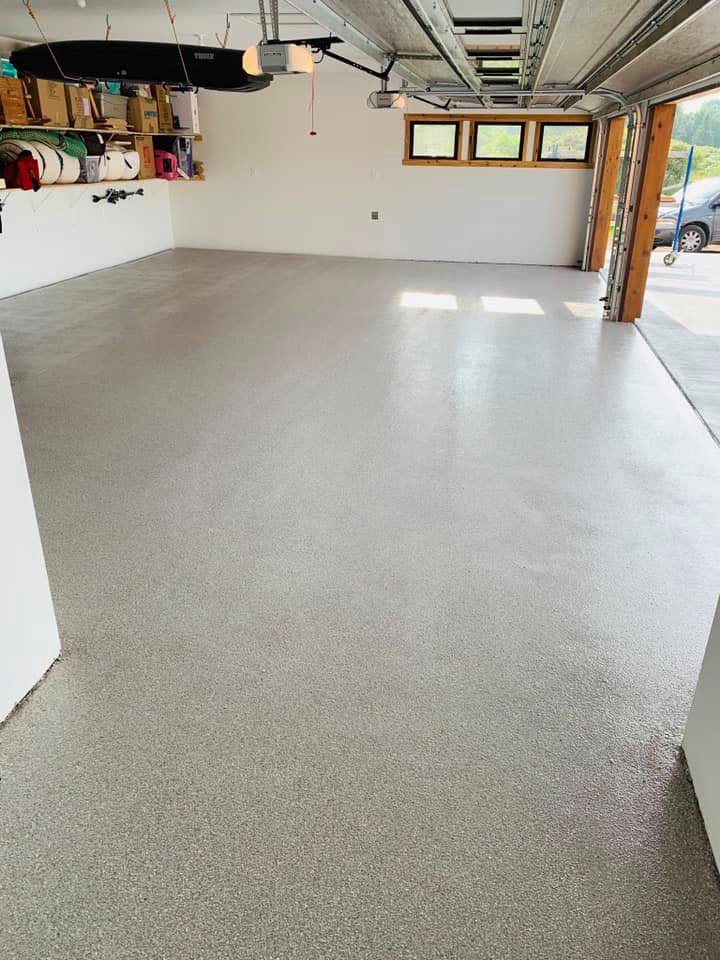
We coat garage floors all day, and current promotional pricing there starts around $2,300 for a two-car and $2,700 for a three-car, installed in one day: walk on it in 4 hours, drive in 24. Those are introductory garage numbers and sit below the per square foot ranges above, because an enclosed slab is a controlled, repeatable job. That slab is out of the rain, out of the UV, and the car parks without turning.

The driveway: the opposite on every count

A driveway is the opposite on every count, at two to three times the square footage. That is why the honest recommendation on many driveways is a wash and a sealer, not a coating.

When we would tell you not to coat:

  • Cracked, spalling, or settling concrete. A coating is about 20 mils thick. It hides nothing structural, and the crack usually telegraphs through within a season.
  • A failed moisture test. High calcium chloride or in-slab RH means a film will blister, and prep alone rarely stops vapor drive.
  • Concrete under 28 days old. Let it cure. Coating green concrete is almost always a callback.
  • A budget under about $3 per square foot. Put it into a pressure wash and a good sealer. A coating that fails in two years costs more than nothing.
  • Selling within a year. A clean, sealed drive photographs nearly as well for about a fifth of the price.
  • A slab due for replacement. New concrete at $8 to $15 per square foot beats $6 to $12 to coat a bad one.

What a concrete driveway coating actually costs here

A 20×20 driveway is 400 square feet: $400 to $1,000 sealed, $2,400 to $4,800 coated in a UV-stable polyaspartic system. A 1,000 square foot drive runs $1,000 to $2,500 sealed or $6,000 to $12,000 coated. Prep is the swing factor: grinding, joint treatment, and crack repair add $1 to $3 per square foot on a neglected slab.

Installed cost per square foot, Northeast Florida

Penetrating silane or siloxane sealer
$1 to $2.50
Heavy prep, added to any coating
$1 to $3
Standard or big-box epoxy
$2 to $5
Cementitious overlay or spray texture
$5 to $10
Polyaspartic or polyurea, UV-stable
$6 to $12
Tear out and replace
$8 to $15

Bars are scaled to the top of the range, with $15 per square foot as full width.

Frequently asked questions

What is the best coating for a concrete driveway?
In Northeast Florida, a UV-stable polyaspartic or polyurea system with a broadcast texture, or a cementitious overlay under a UV-stable topcoat. Both hold color in full sun and flex with a slab that swings 60 degrees between night and afternoon. Standard epoxy is not in the running outdoors.
Is resurfacing a concrete driveway a good idea?
Yes, when the slab is sound and simply looks bad: staining, light scaling, mismatched patches. A cementitious overlay typically runs $5 to $10 per square foot and beats replacement on price. It is the wrong call over active cracks or settlement, because the overlay mirrors what is under it.
Is sealing your concrete driveway worth it?
For most Jacksonville driveways, yes, and usually the more honest answer than a coating. A penetrating silane or siloxane sealer typically runs $1 to $2.50 per square foot and slows salt and moisture intrusion and cuts the staining our humidity produces, and it will not trap vapor because it forms no film. Redo it every 2 to 4 years.
How much does driveway concrete coating cost?
Budget $6 to $12 per square foot installed for a UV-stable polyaspartic or polyurea system and $5 to $10 for a cementitious overlay. Heavy prep adds $1 to $3. Sealing, which is not a coating, runs $1 to $2.50.
What are the downsides of epoxy driveways?
Ambering within 6 to 18 months of Florida sun, chalking by year two or three, and blistering when vapor drives up through a slab with no barrier under it. Add hot tire pickup where you turn the wheel and slipperiness when wet. Outdoors these are the expected outcome, not edge cases.
How long will epoxy last on a driveway?
Expect visible yellowing in 6 to 18 months and functional failure (chalking, peeling at joints, tire lift) in 2 to 3 years. A shaded, north-facing drive might stretch to four. That is a fraction of the 8 to 15 years a UV-stable system gets on the same slab.
What material is better than epoxy?
Polyaspartic and polyurea. Both are aliphatic, so UV does not break them down the way it does epoxy, both stay flexible at 130-degree surface temperatures, and both cure fast enough to install in a day. That is why our work uses Apex polyaspartic floor coating rather than an epoxy topcoat.
Is epoxy good for a driveway?
Not in Florida. It is an excellent interior garage product and a poor exterior one, and the difference is UV and vapor drive, not quality or price. An epoxy base outdoors needs an aliphatic topcoat anyway, so you pay for two products to do one job.
What is the best epoxy coating for driveways?
If a slab is getting epoxy at all, the version that holds up is a 100 percent solids epoxy primer under an aliphatic polyaspartic or polyurea topcoat, which is really a polyaspartic system with an epoxy base. The big-box water-based kits at $2 to $5 per square foot amber and chalk the fastest. Outdoors, skipping the epoxy layer entirely is usually the better answer.

Get a straight answer on your slab

We install polyaspartic and polyurea coatings on garage floors and pool decks across Duval, St. Johns, and Clay counties, and fix the concrete underneath first when it needs it. If you are weighing a driveway, we will walk the slab, check it for moisture and movement, and tell you whether it is worth coating, sealing, or leaving alone. Sometimes that costs us the job. That is fine.

Get Your Free Slab Assessment

Call Apex Flooring at (904) 595-9792

3 Car Garage Flooring for Just $2700

For just $2,700, give your 3-car garage a professional epoxy flooring finish backed by our lifetime warranty. Fill out this form below to take advantage of this limited time offer!

2 Car Garage floors for Just $2300

For just $2,300, give your 2-car garage a professional epoxy flooring finish backed by our lifetime warranty. Fill out this form below to take advantage of this limited time offer!

3 Car Garage Flooring for Just $2700

For just $2,700, give your 3-car garage a professional epoxy flooring finish backed by our lifetime warranty. Fill out this form below to take advantage of this limited time offer!

2 Car Garage floors for Just $2300

For just $2,300, give your 2-car garage a professional epoxy flooring finish backed by our lifetime warranty. Fill out this form below to take advantage of this limited time offer!

Get Started Now

Ready to upgrade your garage with Apex Epoxy Flooring? Fill out the form below, and let us handle the rest. Whether it’s a 2-car or 3-car garage, we’re here to deliver top-notch service.