Search for the best garage floor coating and you will find a hundred kits, a dozen chemistries and plenty of reviews written a week after the floor went down. Almost none of them tell you what actually decides whether a garage floor still looks good years later.
The honest answer is that the best coating depends on the garage. A floor that takes direct afternoon sun through an open door, hot tires off a summer highway and a slab with moisture coming up through it needs something different from a climate-controlled workshop. And on every one of them, the preparation and the way the system is built matter more than the name on the bucket.
Here is how the main garage floor coating types compare, what makes the most durable systems last, and how to choose the right one for a garage in Florida, Georgia or the Carolinas.
The short version. For most homes in our area, the most durable garage floor coating is a professionally installed multi-coat system: a diamond-ground slab, a base coat that bonds deeply into the concrete, a full broadcast of decorative flake or quartz, and a UV-stable polyaspartic topcoat. Epoxy makes an excellent base and a tough, chemical-resistant floor, but on its own it can yellow in sunlight. Thin roll-on kits are the least durable option because they skip the grinding, the thickness and the topcoat. Whatever you choose, moisture testing and crack repair before coating decide how long it lasts.
Garage floor coating types, reviewed
These are the main garage floor coating types you will come across, from an installer’s point of view.
- Epoxy paint and DIY kits. Water-based or solvent-based epoxy sold in kits for a roller. Thin, easy to apply and the least durable. Hot tire pickup and peeling are the common complaints, usually because the concrete was etched rather than ground and the film is too thin.
- 100% solids epoxy. Thick, hard and highly resistant to chemicals and abrasion. An excellent base coat and the workhorse of many commercial floors. Its weakness is sunlight: standard epoxy ambers under UV, so in a garage that gets sun it is usually topcoated.
- Polyurea. Fast curing, flexible and strongly bonding, often used as the base coat. It handles temperature swings well and lets a system go down quickly. See our polyurea floor coating page.
- Polyaspartic. A close relative of polyurea with a workable cure time, strong UV stability and excellent abrasion resistance. It is the topcoat of choice for garages that see sun and can also be used as a full system. Compare it in our polyaspartic vs epoxy guide and our honest look at a polyaspartic garage floor.
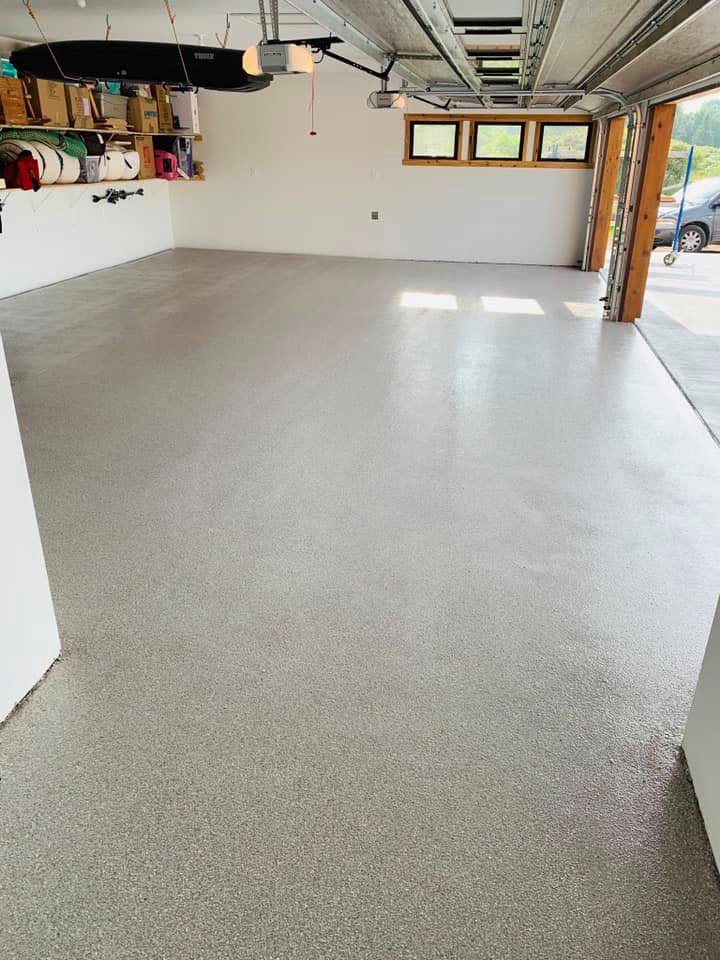
- Flake systems. Not a chemistry but a build: a base coat with decorative vinyl flake broadcast into it, then a clear topcoat. The flake hides imperfections in the slab, adds texture and makes the floor forgiving day to day. See our flake floors.
- Quartz systems. Colored quartz broadcast into the resin in layers. Extremely hard wearing with built-in grip, which is why it also shows up in commercial kitchens and wet areas. See quartz floors.
- Metallic and solid color. Metallic epoxy creates a poured, marbled look and solid color gives a clean, uniform finish. Both are striking, but both show scratches, dust and tire marks more readily than flake or quartz. See metallic and solid color systems.
Garage floor coatings compared
| System |
Durability |
Sun and UV |
Grip |
Hides slab flaws |
Best for |
| DIY epoxy kit |
Low |
Can yellow |
Smooth unless grit is added |
Poorly |
Light use, short-term refresh |
| 100% solids epoxy |
High |
Yellows without a UV topcoat |
Add grit for traction |
Moderately |
Workshops and garages out of direct sun |
| Flake with polyaspartic topcoat |
Very high |
UV stable |
Textured |
Very well |
Most residential garages |
| Quartz |
Very high |
UV stable with the right topcoat |
Built in |
Very well |
Heavy use and wet areas |
| Metallic epoxy |
Moderate to high |
Needs a topcoat in sun |
Smooth |
Poorly |
Showroom look, low-sun garages |
These ratings are relative, and every one of them assumes professional preparation and installation.
What makes the most durable garage floor coating last
Two garages can have the same products and very different results. The difference is almost always in the steps before the coating goes down.
- Diamond grinding, not acid etching. Grinding opens up the concrete so the base coat can bond mechanically. Etching leaves a weaker surface profile and residue, a leading cause of peeling. Our article on why epoxy garage floors peel covers the prep steps in detail.
- Moisture testing. Moisture moving up through a slab pushes coatings off from below. Slabs without a working vapor barrier are common in our region, and a test before coating is cheap insurance. The industry standard for measuring moisture inside a slab is ASTM F2170, and coating manufacturers set the limits for their systems.
- Crack and spall repair. Cracks are opened, filled and ground flush, and damaged surfaces are rebuilt before the base coat goes down. See which garage floor cracks a coating fixes and how spalled concrete is repaired.
- Film build. A multi-coat system with a full broadcast puts far more material on the floor than a roll-on kit, and thickness is what stands up to dropped tools, jack stands and hot tires.
- The right topcoat. A UV-stable topcoat keeps a floor in a sunny garage from yellowing and takes the day-to-day wear.
Heat, sun and humidity in Southern garages
- Sun through the door. Garages that face west or stay open all day get direct UV across the floor, which ambers standard epoxy.
- Hot tires. Tires coming off a summer highway can soften and lift thin coatings, a problem called hot tire pickup. Thick, well-bonded systems resist it. Read more about hot tire pickup.
- Humidity and dew point. A coating applied when the slab is close to the dew point can cure poorly, so installers check slab temperature and humidity on the day.
- Coastal grit. Near the beaches, sand tracked in on tires acts like sandpaper. Harder topcoats and textured finishes hold up better.
Garage floor coating reviews: what they miss
Reviews are useful, but most are written within weeks of installation, when every floor looks good. A few questions get you closer to the truth.
- Can the installer show you floors that are several years old, not just brand-new ones?
- How is the slab prepared: ground or etched?
- Is the concrete tested for moisture before coating?
- How many coats go down, and what is the topcoat?
- What does the warranty cover, specifically peeling and delamination, and for how long?
Our guide to what to look for when hiring an epoxy contractor covers the rest.
Which garage floor coating is best for your garage?
- A daily-driver garage that gets sun: a flake system with a polyaspartic topcoat.
- A workshop with oil and chemicals: an epoxy base with flake or quartz and a chemical-resistant topcoat.
- A wet area, a golf cart garage or a ramp: quartz, or flake with added grip in the topcoat.
- A showroom look: metallic or solid color, accepting that it shows wear more readily, ideally out of direct sun.
Still deciding on the look? Compare flake, metallic, quartz and solid finishes side by side, or browse the epoxy color chart.
Frequently asked questions
What is the best garage floor coating?
For most garages, a professionally installed flake system over a diamond-ground slab, with a strong base coat and a UV-stable polyaspartic topcoat, gives the best balance of durability, looks and easy upkeep. Garages used as workshops, wet areas or showrooms can be better served by quartz, an epoxy-based build or a metallic finish.
How long does a garage floor coating last?
It depends mostly on the preparation and the thickness of the system. Thin roll-on kits can start to wear or peel within a few years, while a properly prepared, multi-coat professional system is built to last many years longer. Moisture in the slab, hot tires and sunlight are the main things that shorten a coating’s life.
Which is better for a garage floor, epoxy or polyurea?
They are often used together. Epoxy is thick, hard and chemical resistant but yellows in sunlight. Polyurea cures fast, stays flexible and bonds strongly, which makes it a good base coat. Many of the best garage systems pair a strong base coat with a UV-stable polyaspartic topcoat rather than relying on one chemistry alone.
Which is better, polyurea or polyaspartic?
Polyaspartic is a type of polyurea formulated to cure more slowly, which gives installers time to work with it and gives the finish excellent UV stability. Standard polyurea cures very quickly and is often used as a base coat. In a garage that gets sun, a polyaspartic topcoat is the usual choice.
What is the downside of epoxy flooring on concrete?
Standard epoxy yellows under UV light, cures more slowly than polyaspartic and depends heavily on surface preparation. On a poorly prepared or damp slab it can peel, and thin epoxy kits are prone to hot tire pickup. Proper grinding, moisture testing and a UV-stable topcoat address most of these weaknesses.
Is a flake garage floor slippery?
A flake floor has more texture than a smooth solid color or metallic finish, so it grips better. It can still get slick when wet, which is why an anti-slip additive can be mixed into the topcoat for garages that see water, golf carts or pool traffic.
Find the right coating for your garage
The best garage floor coating is the one built for your slab and the way you use the space. We will walk the garage with you, test the concrete for moisture, read the cracks and recommend a system that suits it, not a one-size-fits-all kit.
Apex works with in-house crews across Florida, Georgia and South Carolina. See the systems we install on our garage floor coating page.
Request a free assessment